
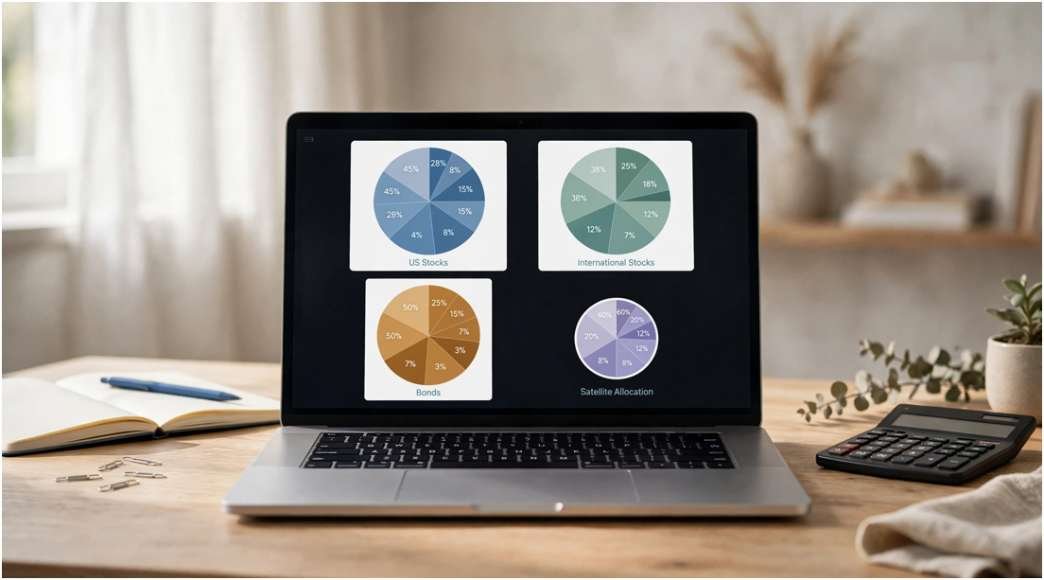
If you are asking how many etfs should i own in my portfolio, my practical answer is usually one to four. You do not need a screen full of ticker symbols to own thousands of investments.
When I assess an ETF portfolio, I rarely start by counting funds. I ask what each fund actually adds. If an ETF does not introduce a new asset class, geographic exposure, or deliberate strategy, adding it may create complexity rather than diversification.
The Short Answer: Most Investors Need 1 to 4 ETFs
For many long-term investors, one broad ETF can provide significant diversification. Two funds offer more control over US and international exposure. Three can introduce bonds. A fourth may support a specific factor or sector tilt.
There is no official rule saying four ETFs is the maximum. The SEC’s Investor.gov makes a more useful point: ETFs can help investors diversify, but several funds can still leave a portfolio concentrated when they own similar securities. It recommends checking fund holdings rather than assuming more funds equal more diversification.
So, how many etfs should i own in my portfolio? I would own only enough to cover the exposures my investment plan actually requires.
Why ETF Count Matters Less Than What You Actually Own

One ETF Can Already Hold Thousands of Investments
A single broad-market ETF can contain more individual securities than most investors realize.
Vanguard Total World Stock ETF, or VT, held 10,048 stocks as of June 30, 2026. Its expense ratio was 0.06%. Vanguard Total Stock Market ETF, or VTI, held 3,531 US stocks and charged 0.03%.
That is why the answer to how many etfs should i own in my portfolio cannot come from ETF count alone. One broad ETF may provide more genuine diversification than six narrowly focused funds.
More ETFs Can Create Hidden Overlap
Suppose I already have a total US stock-market ETF. Adding an S&P 500 ETF may feel like extra diversification.
In reality, much of the second fund sits inside the first. Both can place substantial weight on the same mega-cap companies.
Before adding another fund, I would check how much etf overlap is too much. I compare the investment mandate, major holdings, sector weights, and geographic exposure.
More ticker symbols do not automatically mean more independent investments.
Count Exposure Across All Your Accounts
This is where I think many portfolio discussions miss something useful.
A US investor might hold ETFs in a taxable brokerage account, Roth IRA, traditional IRA, and possibly a 401(k). Looking at each account separately can disguise duplication.
I prefer to view everything as one household portfolio.
If an S&P 500 fund sits in a 401(k) and a total-market ETF sits in a Roth IRA, I would consider their combined exposure before buying another US equity ETF.
That portfolio-level view gives how many etfs should i own in my portfolio a more meaningful answer than simply counting the funds inside one account.
How Many ETFs Should I Own in My Portfolio by Investing Style?
Different portfolios require different building blocks.
| Investing approach | Typical ETF count | What it accomplishes |
| All-in-one equity | 1 | Broad global stock exposure |
| US + international | 2 | Separate control of domestic and foreign stocks |
| Three-fund portfolio | 3 | Stocks plus a broad bond allocation |
| Core + satellite | 4 | Broad core plus one deliberate tilt |
| Specialized strategy | 5+ | Tax, income, factor, or asset-class customization |
If simplicity matters most, fewer ETFs can be an advantage. If precise asset allocation matters more, additional funds may earn their place.
A Simple 1-, 2-, 3-, and 4-ETF Framework

One ETF: Maximum Simplicity
For someone asking how many etfs should i own in my portfolio while prioritizing simplicity, one global equity fund can be enough for the stock portion.
VT, for example, provides exposure to both US and international companies through one ETF.
The trade-off is control. You accept the fund’s market-weighted geographic allocation rather than setting your own.
Two ETFs: US and International Stocks
A two-fund approach separates domestic and foreign equities.
One example is VTI for US stocks and VXUS for international stocks. VXUS held 8,755 stocks across developed and emerging markets outside the United States as of June 30, 2026.
With two funds, an investor can choose a preferred US-to-international allocation.
Three ETFs: Add Bonds
The classic three-fund structure adds a broad bond ETF.
Vanguard Total Bond Market ETF, or BND, held 11,476 bonds as of June 30, 2026. Its expense ratio was 0.03%.
For many investors wondering how many etfs should i own in my portfolio, three offers a strong balance. Each ETF can perform a distinct job without turning rebalancing into an administrative project.
Four ETFs: Add One Intentional Tilt
The fourth ETF needs a reason to exist.
An investor might intentionally add small-cap value, real estate, or another factor exposure. That is different from buying a technology ETF simply because technology stocks recently performed well.
I treat satellite ETFs as optional tools, not required portfolio ingredients.
My Four-Question Test Before Adding Another ETF

Whenever I evaluate another ETF, I ask:
- Does it give me meaningful exposure I do not already have?
- Does it improve my intended stock, bond, US, or international allocation?
- Are its costs reasonable for the exposure provided?
- Can I explain its specific job in one sentence?
That last question is surprisingly effective.
“My other ETFs do not cover this asset class” is a job description. “Everyone seems to be buying it” is not.
My rule is simple: every ETF must earn its seat.
Worked Example: A $10,000 Three-ETF Portfolio
Consider a hypothetical moderate-growth portfolio with $10,000.
An investor could place $6,000, or 60%, into a total US stock-market ETF. Another $2,500, or 25%, could go into an international stock ETF. The remaining $1,500, or 15%, could go into a broad US bond ETF.
The exact allocation is not the lesson. Risk tolerance, age, goals, and time horizon can change the appropriate stock-bond mix.
The useful part is that each fund performs a different job.
If I asked how many etfs should i own in my portfolio after building this allocation, I would not add a fourth fund until I could identify something genuinely missing.
An S&P 500 ETF would mostly duplicate part of the existing US allocation. Another broad international fund could duplicate foreign holdings.
The portfolio may become longer without becoming meaningfully broader.
When Owning More Than Four ETFs Makes Sense
Owning five, six, or even ten ETFs is not automatically wrong.
More funds can make sense when an investor separates developed and emerging markets, uses different bond maturities, applies factor strategies, or manages taxable positions for tax-loss harvesting.
But when someone asks how many etfs should i own in my portfolio, I would not use complexity as a sign of sophistication.
The fifth ETF should solve a real problem. So should the sixth.
If each new fund mostly repeats exposures already present, the investor gets more monitoring, more rebalancing decisions, and potentially more trading without much added diversification. Trading is risky, govt. suggest us to keep an emergency fund to bear all flactuations in the market.
Frequently Asked Questions
1. Is three ETFs enough for a portfolio?
Yes. Three broad ETFs can cover US stocks, international stocks, and bonds.
2. Can I be diversified with only one ETF?
Yes. A broad global ETF can own thousands of securities across multiple countries and industries.
3. How many ETFs should I own in my portfolio as a beginner?
For many beginners, one to three broad ETFs can provide diversification while keeping the portfolio easy to manage.
4. Is owning 10 ETFs too many?
Not necessarily, but 10 ETFs may be excessive if several hold the same companies, sectors, or asset classes.
Your Portfolio Does Not Need a Fund Collection
When I return to how many etfs should i own in my portfolio, my answer stays simple: every fund needs a purpose.
One to four well-chosen ETFs can already provide exposure to thousands of stocks and bonds. More funds are useful only when they add something your existing portfolio genuinely lacks.
So resist the urge to collect ETFs like trading cards.
Open your portfolio instead. Write one job beside every ETF you own. If two funds appear to have the same job, check their overlap before putting another dollar into either one.