
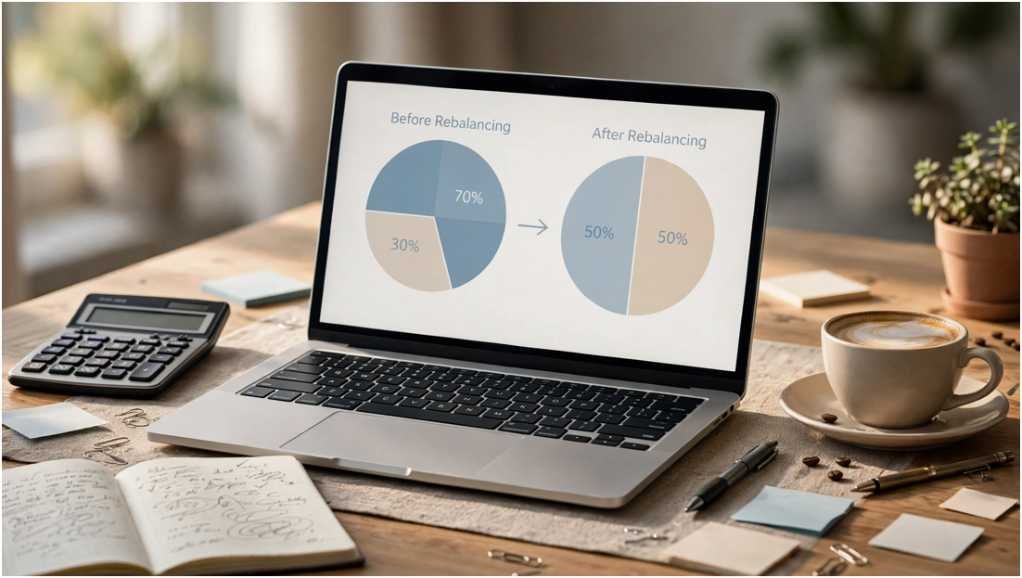
If you are asking how often should i rebalance my portfolio, my starting rule is simple: review it every six to 12 months and consider acting when a major asset class drifts about five percentage points from its target. For many long-term investors, one actual rebalance each year is enough.
I separate checking a portfolio from trading it. That distinction has saved me from turning routine portfolio maintenance into constant tinkering.
The SEC says investors commonly use six- or 12-month schedules or predefined allocation thresholds. It also notes that relatively infrequent rebalancing tends to work best.
The Short Answer: Once a Year Is Usually Enough
When I consider how often should i rebalance my portfolio, I don’t assume every review needs a trade.
Recent Vanguard research reached a similar conclusion. Its analysis found annual rebalancing reasonable for most investors and favorable against several more frequent methods after considering transaction costs.
For quick reference:
| Method | When to Review | When to Rebalance | Best For |
| Calendar | Every 6–12 months | On scheduled date if needed | Simple portfolios |
| Threshold | Periodically | Around 5 percentage points of drift | Risk-focused investors |
| Time + threshold | Every 6 months | Only after meaningful drift | Hands-off investors |
The 5% figure is a rule of thumb, not a federal standard. Vanguard illustrates a similar approach using a 70% stock target and acting after stocks reach 76%.
Portfolio Rebalancing Frequency: Three Ways to Do It

Calendar-Based Rebalancing
Calendar rebalancing is the easiest system to maintain. I choose a fixed review date, compare current allocations with targets, and make adjustments only when necessary.
Its biggest advantage is behavioral. A market correction does not suddenly become a reason to redesign the portfolio.
Threshold-Based Rebalancing
Threshold rebalancing lets asset allocation drift determine the timing.
Suppose my target is 60% stocks. With a five-percentage-point band, I may consider action when stocks reach roughly 65% or fall toward 55%.
This changes the question from how often should i rebalance my portfolio to a better one: how far can my risk exposure move before I need to correct it?
Time-and-Threshold Rebalancing
This is the method I prefer for a typical long-term portfolio.
I review twice a year but make changes only after meaningful drift. It catches risk changes without creating a habit of unnecessary trading.
My Two-Trigger Rule for Asset Allocation Drift
My two-trigger framework makes the process clearer.
The first trigger is time: review the portfolio every six months. The second is material drift: trade only if an important asset class moves about five percentage points from target or the financial plan changes.
That means a review is mandatory, but a transaction is not.
It also depends on portfolio design. If you are deciding between a target date fund vs three fund portfolio, remember that target-date funds generally handle asset allocation changes and rebalancing internally.
A self-managed three-fund portfolio puts that responsibility on you.
A $100,000 Rebalancing Example
Suppose I begin with $100,000:
60% stocks = $60,000
40% bonds = $40,000
After a strong equity market, imagine the portfolio reaches $120,000 with a 70/30 allocation.
Stocks now equal $84,000, while bonds equal $36,000.
A 60/40 allocation at $120,000 would require $72,000 in stocks and $48,000 in bonds. A complete rebalance therefore shifts $12,000 from stocks toward bonds.
That example explains why how often should i rebalance my portfolio is really a risk-management question. Stocks performing well did not make my original risk limit irrelevant.
The SEC similarly explains that investment growth can push a portfolio away from its intended risk level.
Portfolio complexity matters too. If several funds make these calculations difficult, reviewing how many etfs should i own in my portfolio may be more useful than adding another fund.
How Taxes Change the Rebalancing Decision

A perfect allocation on paper can become inefficient after taxes.
Selling appreciated shares in a taxable brokerage account can generate a capital gain. The IRS generally classifies an investment gain as long-term when the asset was held for more than one year.
That is why I cannot answer how often should i rebalance my portfolio properly without considering account type.
Traditional IRAs work differently. The IRS states that amounts inside a traditional IRA, including gains and earnings, generally are not taxed until they are distributed.
For investors with several account types, it can therefore make sense to perform more of the required allocation changes inside tax-advantaged accounts rather than automatically realizing gains in taxable accounts.
Rebalance With New Money Before Selling

When I am still contributing regularly, my first choice is usually to rebalance with new money.
If stocks are overweight and bonds are underweight, new contributions can flow toward bonds until the allocation moves closer to target.
The SEC specifically lists redirecting ongoing contributions toward underweight asset categories as a rebalancing method.
This method can reduce taxable sales and unnecessary trading.
Before solving an allocation problem by buying another fund, I would also check how much etf overlap is too much. Two ETFs with different names can still hold many of the same companies.
When You Should Rebalance Earlier
My annual rule is not absolute.
A portfolio deserves an earlier review when retirement is approaching, the investment goal changes, withdrawals increase, or the investor realizes the current allocation exceeds their true tolerance for losses.
The SEC identifies changes in time horizon, financial circumstances, goals, and risk tolerance as reasons to reconsider asset allocation.
Notice the distinction: changing your target allocation is not the same as rebalancing.
If my old 80/20 allocation no longer suits my situation, blindly rebalancing back to 80/20 would preserve the wrong plan.
When You Should Leave the Portfolio Alone
I do not rebalance because financial news sounds frightening.
I also avoid adjusting a 60% stock target simply because it moves to 60.8%. That level of precision adds activity without meaningfully changing portfolio risk.
Investor.gov explicitly cautions investors against obsessing over portfolio adjustments and recommends considering fees and tax consequences before trading.
So when I ask how often should i rebalance my portfolio, I focus on meaningful deviation rather than perfect percentages.
Rebalance It—Don’t Babysit It
My practical answer to how often should i rebalance my portfolio is once a year for most long-term investors, with a six-month review if tighter oversight feels useful.
My preferred system is even simpler: schedule the review, define a drift threshold in advance, use new contributions first, and sell taxable investments only when necessary.
The important step is deciding your rule before markets become emotional.
Write down your target allocation and your rebalance trigger today. The next market swing should test your plan, not invent it.
Frequently Asked Questions
1. Is rebalancing every month too often?
Usually. Monthly changes can create needless trading and tax friction without materially improving long-term risk control.
2. What is the 5% rule for portfolio rebalancing?
It means considering a rebalance when an asset class moves roughly five percentage points above or below its target allocation.
3. How often should i rebalance my portfolio in retirement?
Review it every six to 12 months and sooner when withdrawals, income needs, time horizon, or risk tolerance materially change.
4. Should I rebalance my 401(k) every year?
An annual review is a sensible baseline, but you only need to trade when your allocation or retirement plan actually requires adjustment.