
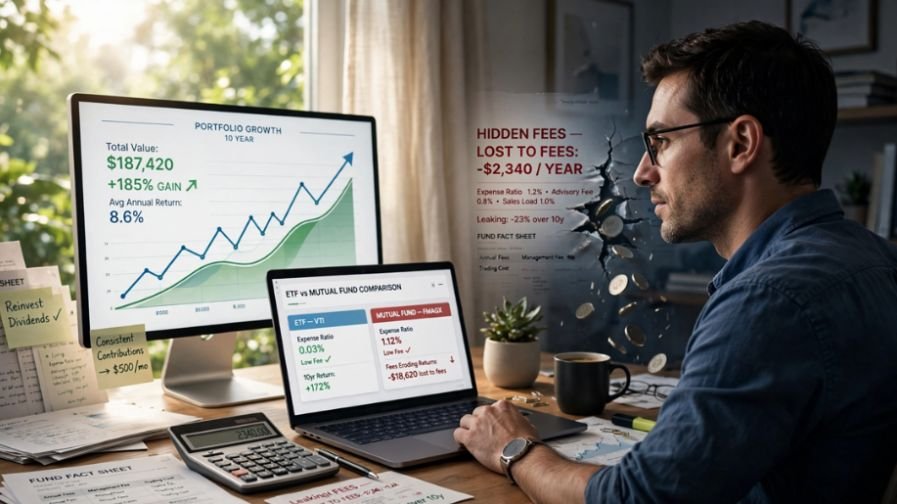
A small percentage can quietly cost you thousands of dollars over your investing lifetime. When I started comparing investment funds, I realized that fees were one of the easiest factors to overlook because they never appeared as a separate bill.
What is an expense ratio and how does it affect returns? It is the annual fee a mutual fund, index fund, or ETF charges to operate and manage the portfolio. This cost is deducted automatically from the fund’s assets, reducing the return investors actually receive.
The difference between a 0.10% fund and a 1.50% fund may look tiny today, but decades of compounding can turn that gap into a major difference in retirement wealth.
What Is An Expense Ratio In Investing?

An expense ratio represents the percentage of a fund’s assets used each year to cover operating expenses. These expenses may include portfolio management, administration, record keeping, and other fund-related costs.
For example, if I invest $10,000 in a fund with a 1% expense ratio, approximately $100 goes toward fund expenses each year. I do not manually pay this amount. Instead, the fund deducts it before calculating the returns reported to investors.
The formula is simple:
Expense ratio = Annual fund operating expenses ÷ Average fund assets
A lower expense ratio means more of the investment growth stays invested.
How Does An Expense Ratio Affect Returns Over Time?
The biggest mistake I see investors make is treating fees as a one-time cost. They are not. Expense ratios create a continuous drag on compounding.
A fund may generate an 8% annual return before expenses. If the expense ratio is 1%, the investor receives roughly 7% before considering taxes or other costs. The fee difference continues every year, reducing future growth potential.
A Real Example Of Expense Ratio Impact
I compared three hypothetical funds with the same investment amount and growth period:
| Fund Type | Annual Expense Ratio | Final Value After 30 Years | Lost To Fees |
| Low-Cost Index Fund | 0.10% | ₹97,86,854 | ₹2,75,813 |
| Average Mutual Fund | 0.75% | ₹81,25,934 | ₹19,36,733 |
| High-Cost Active Fund | 1.50% | ₹66,13,837 | ₹34,48,830 |
The surprising part is that the high-cost fund does not simply lose the fee amount. It also loses decades of potential growth from the money removed from the portfolio.
A 1.5% expense ratio can reduce long-term wealth by more than ₹34 lakh in this example.
Expense Ratio Impact On Mutual Funds And ETFs

Different investment styles usually have different cost structures.
Passive Funds Usually Have Lower Expense Ratios
Index funds and ETFs typically follow a market index instead of relying on frequent buying and selling decisions. Because they require less active management, many passive funds have lower fees.
Common passive fund expense ratios often range from around 0.05% to 0.30%.
For example, broad-market index funds that track benchmarks like the S&P 500 generally focus on matching market performance rather than attempting to beat it.
This lower-cost approach is one reason many investors include passive funds when learning how to choose an etf.
Active Funds Often Charge Higher Fees
Active funds employ professional managers who research companies, adjust holdings, and attempt to outperform a benchmark.
That additional management can increase costs. Active mutual funds may have expense ratios ranging from approximately 0.75% to above 2%.
A higher fee can make it harder for a fund manager to outperform because the investment must first overcome the additional cost.
Why Small Fee Differences Matter For Retirement Investors

When I look at retirement investing, I focus less on short-term performance and more on what remains after decades of fees.
A difference of 1% may not feel significant in one year. Over 30 years, however, the impact can become dramatic because every dollar lost today also loses future compounding.
This is why many retirement investors compare costs alongside diversification, risk, and investment strategy. A low-cost approach can help preserve more wealth without requiring additional savings.
Investors building retirement portfolios often combine this thinking with strategies like how to build a three fund portfolio for retirement, where controlling unnecessary costs is a key consideration.
Are Higher Expense Ratios Worth Paying?
A higher expense ratio is not automatically bad. Some specialized funds may provide strategies, research, or access to specific markets.
However, a higher fee should have a clear reason behind it.
I avoid paying extra simply because a fund advertises strong past performance. Past results do not guarantee future returns, and higher fees can reduce the benefit of similar performance. Vanguard also highlights that comparing costs matters because higher fees can reduce future investment outcomes.
Before choosing a fund, I check:
- The expense ratio compared with similar funds
- The fund’s investment strategy
- Long-term performance after fees
- Portfolio diversification
- Tax efficiency
The goal is not always choosing the cheapest fund. The goal is avoiding unnecessary costs that reduce long-term returns.
How To Reduce The Impact Of Expense Ratios
Reducing investment costs does not require complicated strategies. I focus on a few simple habits:
Compare Similar Funds
Two funds may follow similar strategies but charge very different fees. Comparing expense ratios can reveal whether the extra cost provides meaningful value.
Understand What You Own
A low-cost ETF and an expensive actively managed fund may serve completely different purposes. Cost should always match the investment objective.
Think Long Term
Short-term differences may appear small, but compounding magnifies them over decades. Investors saving for retirement have the most time for fees to either help or hurt them.
For investors expanding beyond workplace retirement accounts, understanding costs is also important when exploring what to invest in after maxing out 401k and Roth IRA.
Frequently Asked Questions
1. What is a good expense ratio for an index fund?
Many low-cost index funds have expense ratios below 0.30%, with some broad-market funds charging much less.
2. Does a higher expense ratio mean better returns?
No. Higher fees do not guarantee better performance and can reduce the returns investors keep.
3. How does an expense ratio affect ETF returns?
An ETF expense ratio reduces the fund’s net return because operating costs are deducted from the fund’s assets before returns reach investors.
4. Can expense ratios affect retirement savings?
Yes. Even small annual fees can significantly reduce retirement wealth because they lower the amount available for future compounding.
The Fee That Quietly Eats Your Future Wealth
I think of expense ratios as a silent leak in an investment bucket. A small leak may not look serious today, but years of lost growth can create a much bigger problem.
My next step would be simple: check the expense ratio of every fund I own and compare it with similar alternatives. Saving even a fraction of a percentage point can protect more of my money for the future.
Low costs do not guarantee investment success, but unnecessary high fees can make the journey much harder. Choosing wisely today gives compounding more room to work tomorrow.