
When I think about how to invest for a house down payment in 5 years, I care less about beating the stock market than having the money available on closing day. A five-year deadline changes the investing equation.
The SEC’s Investor.gov warns that investors saving for goals five years away or less may not want risky investments. A market decline could force them to sell at a loss exactly when the money is needed.
My approach is therefore simple: build enough growth potential early, then make the portfolio increasingly boring.
Start With the Real Amount You Need
The first mistake I avoid is treating the down payment as the entire savings goal.
Suppose I expect to buy a $500,000 home. A 15% down payment equals $75,000, but that does not mean $75,000 is my target.
The Consumer Financial Protection Bureau says closing costs typically run around 2% to 5% of the purchase price, excluding the down payment. Buyers should also preserve money for moving, repairs, furnishings, and an emergency cushion.
Using a 4% closing-cost assumption creates this target:
| Goal component | Estimated amount |
| 15% down payment | $75,000 |
| 4% closing costs | $20,000 |
| Moving/home setup buffer | $5,000 |
| Total target | $100,000 |
That calculation changes how to invest for a house down payment in 5 years because I now have a realistic finish line rather than an arbitrary savings number.
CFPB also notes that some mortgages allow down payments as low as 3%, while many require at least 5%. Putting less than 20% down may also mean paying mortgage insurance.
The Best Investments for a Five-Year House Fund
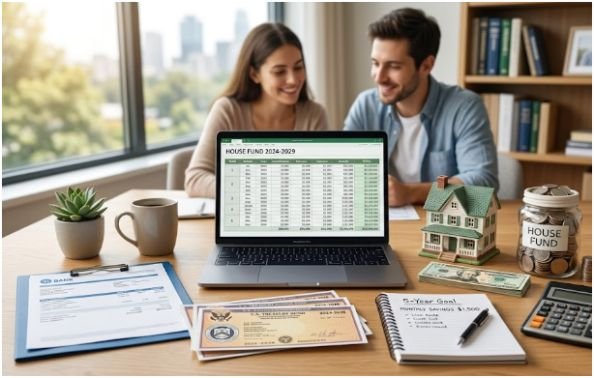
For this goal, I prioritize liquidity, capital preservation, and predictable maturity dates.
High-Yield Savings and Money Market Deposit Accounts
A high-yield savings account is useful for money I may need soon. I also like it for the final stage of the plan because the balance does not fluctuate with financial markets.
Eligible savings accounts, CDs, and money market deposit accounts at FDIC-insured banks receive coverage up to applicable limits. The standard limit is $250,000 per depositor, per insured bank, per ownership category.
That protection makes insured deposits especially useful when closing is less than two years away.
CDs and Treasury Bills
CDs can work when I know I will not need a portion of the money before a specific date. I can also create a CD ladder instead of locking everything into one maturity.
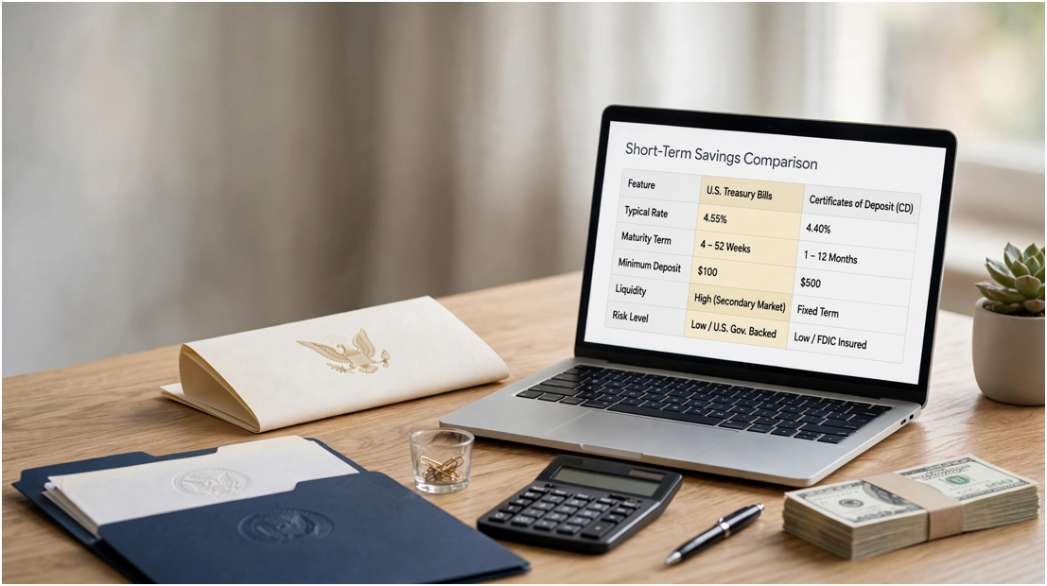
Treasury bills offer another short-term option. TreasuryDirect currently issues T-bills with maturities ranging from four to 52 weeks. Interest is subject to federal tax but exempt from state and local income taxes.
When comparing fixed-income choices, understanding bond funds vs individual bonds helps because a bond fund has no guaranteed maturity value. An individual bond or Treasury held to maturity behaves differently.
Bonds and Limited Stock Exposure
I would not automatically put a five-year house fund entirely into stocks.
A diversified stock fund may provide better long-term growth, but five years does not guarantee enough recovery time after a major decline.
For someone comfortable accepting some uncertainty, a modest stock allocation during the early years may be reasonable. The key word is modest.
The same principles behind asset allocation for retirement apply here, but the time horizons differ dramatically. Retirement money may remain invested for decades. House money has a date attached to it.
A Five-Year Investment Strategy That Reduces Risk

My preferred method for how to invest for a house down payment in 5 years is a scheduled step-down strategy.
| Time remaining | Illustrative approach |
| Years 5–4 | Mostly cash/fixed income, with limited diversified equity if appropriate |
| Years 3–2 | Reduce equity exposure and increase Treasuries, CDs and cash |
| Final 12 months | Prioritize cash, short-term Treasuries and insured deposits |
This is not a universal asset allocation. Risk tolerance, income stability, existing savings, and purchase flexibility matter.
The important part is the direction of travel. The closer I get to buying, the less market risk I want.
If stocks perform well during year two, I do not treat those gains as permission to gamble more. I gradually lock them in.
Worked Example: Building a $100,000 Home Fund
Here is the calculation I find most useful.
Assume I need $100,000 in exactly five years and begin with $0.
Without investment returns, I need roughly $1,667 per month for 60 months.
At a hypothetical 4% annual return compounded monthly, the required contribution falls to about $1,508 per month.
At 6%, it falls to roughly $1,433.
That difference exposes a trap in how to invest for a house down payment in 5 years: increasing expected returns makes the savings target look easier, but higher expected returns normally require accepting more uncertainty.
I would rather increase my monthly contribution by $100 than build a plan that fails if stocks fall 25% during year five.
That is my “risk-budget” rule: use investment returns as a bonus, not as the only reason the home purchase works.
Where Should You Keep Your House Fund?

I prefer keeping house savings separate from everyday checking and retirement money. Mixing goals makes it too easy to spend the fund or misjudge progress.
A dedicated savings account or taxable brokerage account also makes tracking easier.
There are major differences between retirement and taxable accounts, so I would understand roth ira vs taxable brokerage account before choosing where investments belong. Retirement accounts have tax advantages, but I generally do not build a house plan around withdrawing retirement savings.
Taxable investments also create tax considerations. The IRS generally classifies investments held for more than one year as long-term when calculating capital gains. Mutual funds can also distribute taxable capital gains even without the investor selling shares.
I therefore calculate my target using the amount I expect to have after likely taxes and transaction costs.
Mistakes That Can Push Your Home Purchase Back
The biggest mistake with how to invest for a house down payment in 5 years is taking the same risk in month 59 that I took in month one.
I also avoid assuming that 20% down is mandatory. A larger down payment can lower borrowing costs, but draining every dollar for closing can leave a new homeowner financially fragile.
Another mistake is ignoring emergency savings. CFPB recommends preserving an emergency cushion, commonly three to six months of expenses, rather than putting every available dollar toward closing.
Finally, I revisit my target once or twice each year. Home prices, income, mortgage options, and my preferred neighborhood can all change.
Your House Fund Should Get Boring Before Closing
For me, success with how to invest for a house down payment in 5 years is not having the most impressive return. It is reaching year five with enough accessible money to make an offer without praying for the market to cooperate.
I would calculate the full cash-to-close target, automate monthly contributions, use limited risk early, and begin de-risking well before the purchase.
The final move is simple: once the house shifts from “five-year goal” to “next-year purchase,” stop asking how much more the money could earn. Start asking how much of it I can protect.
Frequently Asked Questions
1. What is the safest way to invest a house down payment for five years?
FDIC-insured savings, CDs, and short-term Treasuries can prioritize principal protection, especially as the purchase date approaches.
2. Should I invest my house down payment in stocks?
A limited allocation may suit some investors early on, but relying heavily on stocks creates significant timing risk for a five-year goal.
3. How much should I save monthly for a house in five years?
Divide your full target by 60 as a conservative starting point, then adjust for existing savings and realistic investment returns.
4. How to invest for a house down payment in 5 years if I am risk-averse?
I would emphasize insured savings, CDs, and short-term Treasuries rather than depending on stock-market growth.