

When I compare bond funds vs individual bonds for beginners, I do not start by asking which investment earns more. I ask a simpler question: what job does this money need to perform?
If I want easy diversification inside a long-term portfolio, a bond fund usually makes more sense. If I need a defined amount of money on a specific future date, an individual high-quality bond can offer something a traditional bond fund cannot: a known maturity date.
That distinction makes the choice much clearer.
Bond Funds vs Individual Bonds at a Glance
| Feature | Bond Funds | Individual Bonds |
| Diversification | Usually high | Depends on number purchased |
| Maturity date | Usually none | Fixed |
| Starting amount | Often very low | Varies; Treasuries start at $100 |
| Income | Distributions can change | Coupon usually fixed |
| Price movement | NAV/share price changes | Market price changes before maturity |
| Principal at maturity | No fund-level maturity | Face value due if issuer pays |
| Management | Mostly hands-off | More research required |
| Costs | Expense ratio and trading costs | Markups, markdowns, or commissions |
The SEC’s Investor.gov warns that bond funds can lose money from credit risk, interest-rate risk, and other factors. A fund’s value can decline even when it owns government securities.
How Bond Funds Work for Beginner Investors
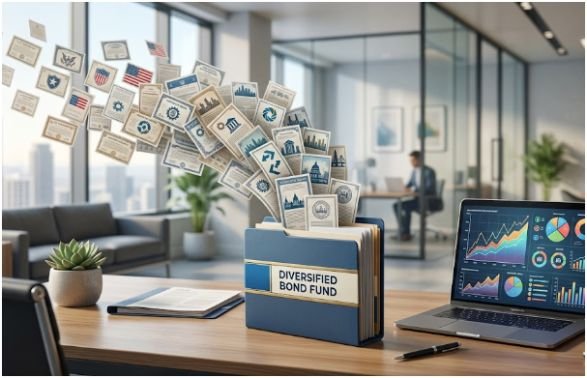
A bond fund pools investors’ money and owns many debt securities. Those holdings might include Treasury securities, corporate bonds, mortgage-backed securities, or municipal debt.
Diversification and Simplicity
Diversification is the strongest argument for bond funds.
Buying one broad fund can expose me to hundreds or thousands of securities. If one corporate issuer defaults, the effect on a diversified portfolio may be far smaller than owning that company’s bond directly.
This is why I often view bond funds vs individual bonds for beginners as a diversification decision rather than a return contest.
Bond funds can also work well when learning how to choose asset allocation for retirement. I can set a target bond allocation, contribute regularly, and rebalance without maintaining dozens of separate maturity dates.
Interest Rate Risk and Duration
Bond funds are not cash substitutes.
When market interest rates rise, existing bonds with lower rates generally lose market value. That decline affects a bond fund’s share price.
Duration helps estimate the sensitivity. FINRA explains that a bond investment with a six-year duration could decline roughly 6% if interest rates rose one percentage point, assuming other factors remained similar. Duration works in the opposite direction when rates fall.
The estimate is not a guaranteed outcome, but I find duration far more useful than simply looking at a fund’s yield.
How Individual Bonds Work

An individual bond is a loan made to one issuer. I buy the bond, potentially receive interest, and receive its face value when it matures if the issuer meets its obligations.
Maturity and Predictable Cash Flow
This is where individual bonds become attractive.
Treasury notes, for example, have defined maturity dates and pay fixed interest every six months. TreasuryDirect currently offers notes with maturities of 2, 3, 5, 7, and 10 years.
A common beginner misconception is that individual bonds always need at least $1,000. Marketable Treasury securities can currently be purchased through TreasuryDirect from $100 in $100 increments.
That makes individual Treasuries more accessible than many investors assume.
Credit, Liquidity, and Pricing Risk
Predictable maturity does not mean risk-free.
A corporate issuer can default. A callable bond could also be redeemed earlier than expected. And if I sell before maturity, market rates may force me to accept less than I originally paid.
Trading costs deserve attention too. FINRA notes that brokers may earn compensation through a markup when selling a bond or a markdown when buying one from an investor.
That cost can be less obvious than a fund’s published expense ratio.
Bond Fund vs Individual Bond Costs and Taxes

Bond funds usually charge an annual expense ratio. Even a small percentage reduces returns over time, so I compare funds with similar strategies rather than choosing by yield alone.
Individual bonds do not normally charge a fund management fee. However, spreads, commissions, premiums, and markups can affect the true yield.
Taxes also change the comparison.
Interest from U.S. Treasury bills, notes, and bonds is subject to federal income tax but exempt from state and local income taxes.
Account type matters as well. Someone comparing a roth ira vs taxable brokerage account should consider where interest-producing investments fit within the entire tax strategy rather than evaluating a bond in isolation.
A $10,000 Example: Why Your Goal Changes the Answer
Suppose I have $10,000.
If the money is part of a retirement portfolio I will hold for decades, I might prefer a diversified bond fund. I gain broad exposure and can keep adding money automatically.
Now suppose I need approximately $10,000 for a known expense five years from now.
A five-year Treasury held to maturity serves a different purpose. I know when the principal is scheduled to return.
Compare that with a hypothetical bond fund carrying a duration of six years. If rates suddenly rose one percentage point, duration suggests an initial price decline of roughly 6%, or about $600 on $10,000. Future interest payments and reinvestment at higher rates may offset part of that decline over time, but the fund does not promise that my account will equal exactly $10,000 on my chosen date.
That goal-matching difference is the most useful way I know to evaluate bond funds vs individual bonds for beginners.
Which Is Better for Retirement Investing?
For most long-term retirement portfolios, I would lean toward a diversified, low-cost bond fund.
Retirement investing involves decades of contributions, withdrawals, and rebalancing. Maintaining dozens of individual bonds can create unnecessary work.
Bond funds also make it easier to maintain a chosen stock-to-bond allocation.
Individual bonds become more compelling near retirement when I want to match specific spending years. A ladder of Treasuries or other high-quality bonds can create scheduled maturity payments while the rest of the portfolio remains invested.
Which Is Better for Short-Term Goals?
For money tied to a specific date, individual Treasuries deserve serious consideration.
Suppose I know I need funds in 12 months. A Treasury security that matures around that date removes the need to sell a bond fund at whatever market price happens to exist then.
Investors considering very short horizons may also want to compare treasury bills vs cds for short term savings, because both can provide more defined outcomes than a traditional bond fund.
Treasury bills currently have maturities ranging from four to 52 weeks and can be purchased from $100.
How I Would Choose as a Beginner
My rule is simple: I choose the investment based on the liability.
I would favor a bond fund when I want diversification, automatic investing, easy rebalancing, and long-term fixed-income exposure.
I would favor individual high-quality bonds when the money has a defined purpose and a defined date.
I would be more cautious with individual corporate bonds. A beginner with limited capital may struggle to diversify credit risk adequately.
That means the answer to bond funds vs individual bonds for beginners changes according to time horizon, not merely expected yield.
Frequently Asked Questions
1. Are bond funds or individual bonds safer for beginners?
Neither is automatically safer; diversified funds reduce issuer concentration, while high-quality individual bonds held to maturity can provide more predictable principal repayment.
2. Can I lose money in a bond fund?
Yes. Rising interest rates, defaults, prepayments, and other risks can reduce a bond fund’s value.
3. Are individual Treasury bonds good for beginners?
They can be, especially for defined goals, because Treasury marketable securities start at $100 and have known maturity dates.
4. What is the simplest choice in bond funds vs individual bonds for beginners?
A diversified bond fund is usually simpler for ongoing investing, while an individual Treasury may fit a specific future spending date better.
Pick the Job Before You Pick the Bond
I would not choose a bond because its yield looks attractive on a brokerage screen. I would decide what I need the money to accomplish first.
For long-term diversification, I favor the simplicity of a broad bond fund. For a known expense on a known date, I prefer the clarity that a carefully matched individual bond can provide.
That is the practical advantage of understanding bond funds vs individual bonds for beginners: the winner is not a product. The winner is the investment that matches the job.
Before buying anything, I would check three numbers: the time until I need the money, the investment’s duration or maturity, and its total cost. Those three numbers usually reveal more than the headline yield.