

I have noticed how different borrowing feels now compared with even a few years ago. A personal loan can start with a few taps on a phone, while another option may still involve a bank representative, paperwork, and a more traditional review. Having both choices sounds simple, but the faster option is not automatically the cheaper one.
I also found that the real question is less about which type of lender is better and more about which process fits the borrower’s situation. Someone who needs money quickly may value a streamlined digital application, while someone planning a larger expense may care more about the rate, loan terms, and support available throughout repayment. Looking at those differences can make the decision much clearer.
What Digital Lending Really Means
Digital lending refers to borrowing where much or all of the application and approval process happens electronically. A borrower may complete an application online, upload documents, verify identity digitally, receive an automated decision, and manage the loan through an online account.
The biggest appeal is convenience. There is no need to arrange a branch visit just to submit basic information, and some lenders can process applications quickly.
Technology can also change how an application is evaluated. Some lenders use automated underwriting and may consider information beyond a traditional credit file, including permissioned cash-flow data. Federal Reserve research notes that financial alternative data can help lenders evaluate repayment capacity and potentially expand access for some consumers with limited credit histories.
That does not mean every digital lender has flexible requirements or that every applicant will qualify. It simply means the underwriting process can be built around more than one traditional measure.
How Traditional Bank Loans Work

Traditional bank lending usually involves a more established underwriting process. Depending on the lender and loan type, borrowers may provide income information, employment details, bank statements, tax documents, and other financial records.
The process can feel slower, particularly when a loan requires detailed verification. In return, borrowers may have access to a loan officer, branch support, and an existing relationship with the institution.
Traditional lending is not necessarily stuck in a paper-based process, either. Many banks now offer online applications, electronic document uploads, automated decisions, and digital account management. The line between a “traditional bank loan” and a “digital loan” is therefore becoming less rigid.
In fact, banks can use technology and alternative data as part of their own lending processes. The Federal Reserve has noted that banks are increasingly using automated underwriting and cash-flow information in certain credit products.
Digital Lending vs Traditional Bank Loans: The Main Differences
The biggest differences usually come down to speed, convenience, underwriting, cost, and customer support.
Digital lenders can be attractive when the application needs to move quickly. Traditional banks may appeal more to borrowers who value established relationships or want direct assistance.
Neither model guarantees a lower rate. Your credit history, income, debt obligations, loan amount, term, and overall financial profile can influence the offer you receive.
Speed and convenience
Digital applications generally remove much of the physical paperwork associated with borrowing. Documents can be uploaded electronically, and automated systems can process information without waiting for every step to be handled manually.
Traditional banks can also move quickly when their processes are highly automated. A branch-based lender is not automatically slow, just as an online lender is not automatically fast.
The important question is how quickly you need the funds and whether the lender can provide them without adding unnecessary cost.
Eligibility and underwriting
This is one of the more interesting differences.
A conventional credit score remains an important part of many lending decisions, but some lenders also examine income, existing obligations, account activity, and other information. Alternative financial data can sometimes provide additional insight into whether someone has the ability to repay.
For borrowers with limited credit histories, that distinction can matter.
If you have been researching online personal loan application trends, you may have noticed how much the borrowing process has shifted toward digital verification, automated decisions, and easier application tracking. That convenience can be useful, but borrowers should still compare the actual loan offer rather than choosing based on the application experience alone.
Look Beyond the Advertised Interest Rate
A loan with a lower interest rate is not necessarily the least expensive option.
Check the APR, because it can provide a broader picture of borrowing costs. Also look for origination fees, late fees, prepayment terms, the repayment period, and the total amount you will repay.
The loan term deserves special attention. A longer term can reduce the required monthly payment, but it can also mean paying interest for a longer period.
Monthly affordability matters, but it should not be the only measure. A payment that fits comfortably into your budget can still come with a much higher total cost.
This becomes especially important if you are considering debt consolidation. Understanding how debt consolidation affects monthly payments means looking beyond whether the new payment is smaller. A lower monthly bill can result from extending the repayment period, while a shorter term could require a larger payment but reduce the total interest paid.
When a Traditional Bank May Make More Sense

A traditional bank can be worth considering when you have time to compare offers and already have a strong relationship with the institution.
Existing customers may have access to account-based benefits, established service channels, or a loan officer who understands some of their financial history. That personal assistance can be valuable when the borrowing situation is more complicated than a straightforward personal loan.
A bank may also make more sense when you are seeking a larger amount or a specialized lending product. The right choice still depends on the specific loan, because lending policies vary widely from one institution to another.
When Digital Lending May Be the Better Fit
Digital lending can make sense when convenience and speed are high priorities.
Someone with a busy schedule may prefer completing an application at home rather than arranging a branch appointment. A borrower who wants to compare several offers may also appreciate being able to review options electronically.
However, convenience should never become a reason to skip the fine print.
Before accepting an offer, check the APR, fees, repayment schedule, total repayment amount, and any conditions attached to the loan. Also make sure the lender is legitimate and that you understand what information you are providing.
Credit Scores Are Only Part of the Picture
It is easy to assume that a credit score determines everything. In reality, lenders can consider several parts of an applicant’s financial profile.
Income and employment can help establish repayment capacity. Existing debt affects how much room remains in the monthly budget. Payment history provides information about past behavior. Some underwriting systems may also evaluate cash-flow information or other permitted data.
That is why understanding what lenders look for beyond credit scores can help you prepare for a loan application. A strong score is useful, but it does not replace stable income or reasonable debt levels. Likewise, a weaker score does not always tell the entire story of someone’s ability to repay.
Alternative data can broaden the information available to lenders, but it also creates responsibilities around accuracy, transparency, privacy, and fair lending.
Which Option Fits Your Situation?
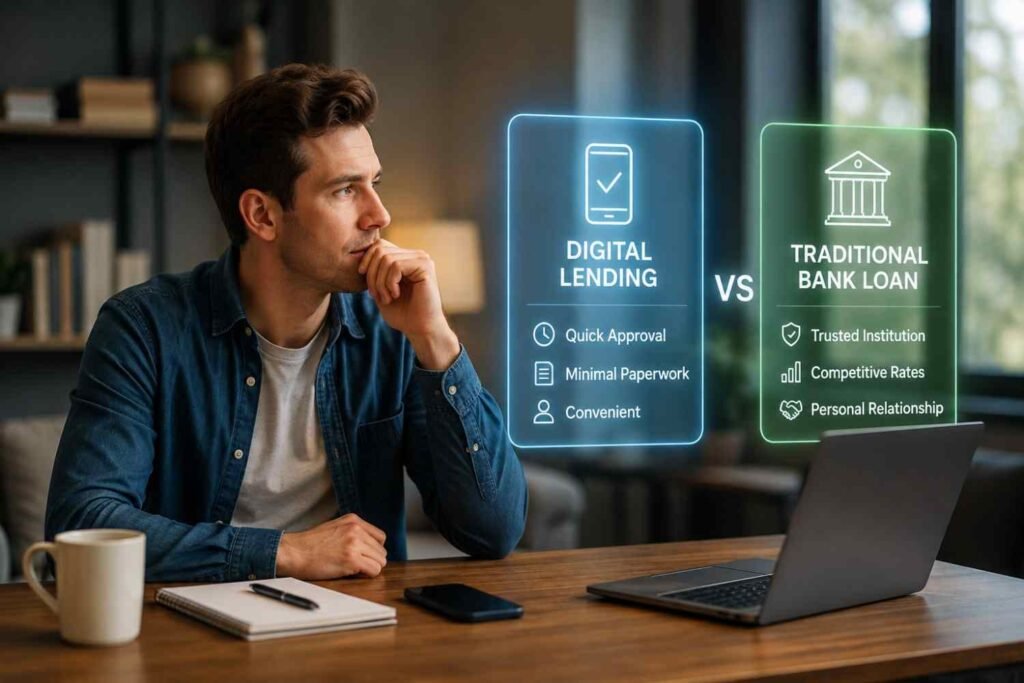
Digital lending may suit you better if you value a remote application, quick processing, electronic document handling, and easy account access.
A traditional bank may be a better fit if you prefer personal assistance, already have a banking relationship, have time to compare options, or need a more involved lending product.
There is also a middle ground. A bank can provide a largely digital loan experience, while a technology-focused lender can still involve human support. The label matters less than the actual terms you receive.
Before applying, compare at least a few offers when possible. Look at the APR, fees, monthly payment, term, total repayment, funding timeline, and eligibility requirements. That gives you a much better basis for choosing than simply asking whether the lender is online or traditional.
FAQs: Digital Lending vs Traditional Bank Loans: Which Fits You?
1. Are digital loans cheaper than bank loans?
Not automatically. Digital lenders may have efficient processes, but your rate and fees depend on your financial profile and the specific lender.
2. Are traditional bank loans always slower?
No. Many banks now use digital applications and automated underwriting, so processing times can vary significantly.
3. Can digital lenders approve borrowers with lower credit scores?
Some may consider additional financial information beyond traditional credit data, but approval and pricing still depend on the lender’s underwriting requirements.
4. What should I compare before choosing a loan?
Compare APR, fees, monthly payment, loan term, total repayment, funding time, and eligibility requirements. Do not choose based on speed alone.
The Better Loan Is the One That Fits the Full Picture
There is no universal winner in the digital lending vs traditional bank loans comparison. The better option depends on what matters most to you and what the actual loan offer looks like. Fast funding can be valuable when timing matters, but a convenient application is not worth much if the loan carries costs you could have avoided elsewhere. Likewise, a traditional bank is not automatically the better choice simply because it has branches or a familiar name.
Take the time to compare the complete offer. The right borrowing decision is the one that works not only when you receive the money, but also months later when the payments become part of your regular budget.